Wireless environmental monitoring node
Design of a compact node integrating temperature, humidity, pressure and volatile organic compound sensing with wireless connectivity.
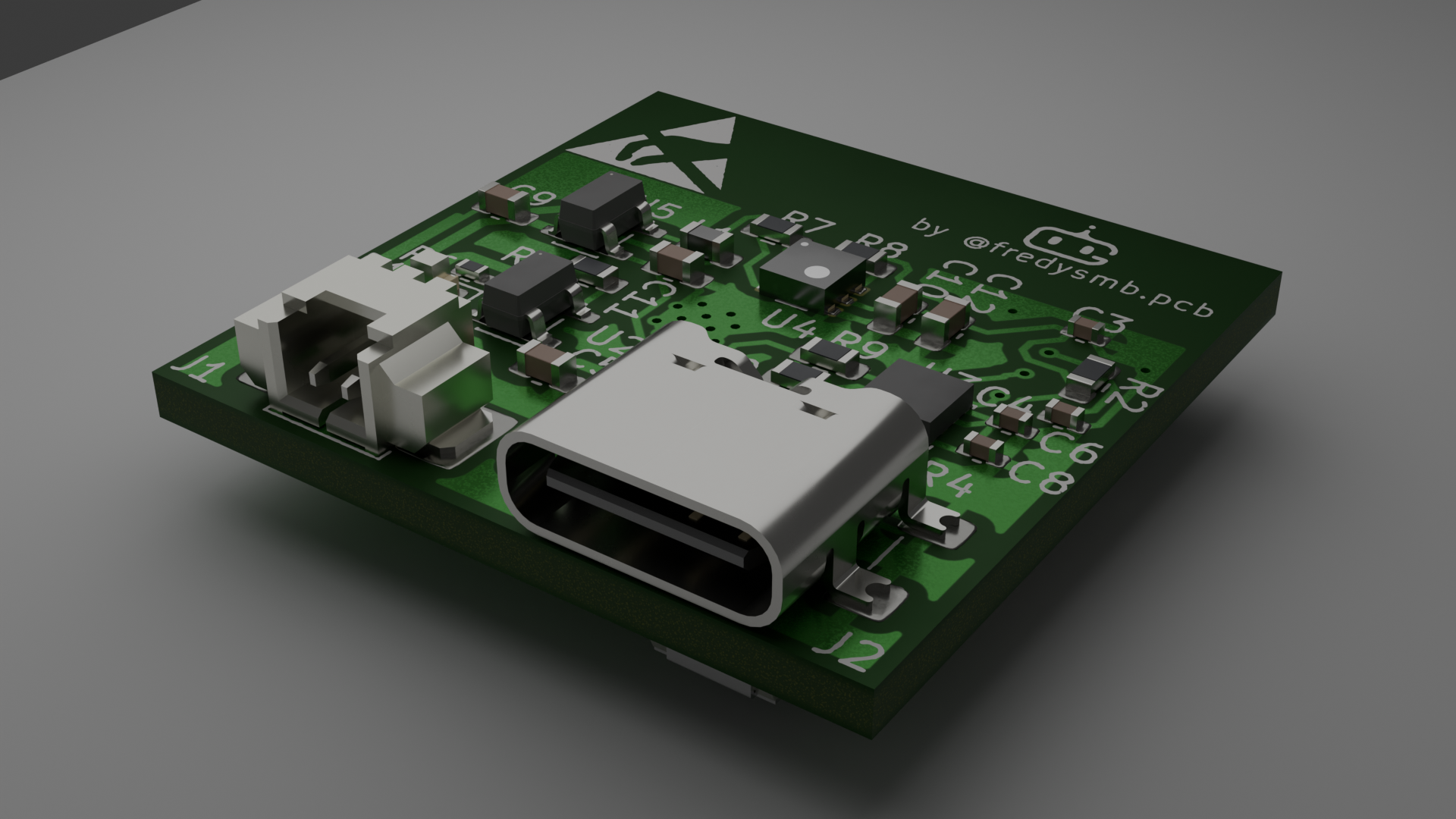
Electrical and functional performance requires testing on physical hardware. No unmeasured results are presented as verified.
The problem
Integrate environmental sensing, autonomous power, USB-C charging and communications on a compact board while accounting for power draw and thermal influence on measurements.
Requirements and scope
- BME280 temperature, humidity and pressure measurement.
- VOC sensing with SGP40 (not equivalent to comprehensive air-quality measurement).
- Processing and wireless connectivity using ESP32-C3.
- Battery supply and USB-C charging input.
- Programming, debugging access and manufacturing documentation.
System architecture
The architecture centers on the ESP32-C3, connecting digital sensors and dedicated charging and regulation blocks. Logical separation of power, sensing and communications makes subsystem reviews easier.
Engineering decisions
- ESP32-C3 for control and integrated wireless connectivity.
- BME280 and SGP40 to combine environmental variables and VOC sensing.
- TPS62203 regulation and a power path that still needs experimental verification.
- Sensor placement and thermal effects as factors requiring measurement.
Verification plan
- Measure supply rails under battery operation and charging.
- Record active and idle current; estimate autonomy from actual measurements.
- Compare sensor readings against known references.
- Check local temperature, connectivity and firmware stability.
Outcome and limitations
The architecture, schematic, PCB and fabrication documentation are prepared. Physical evidence for autonomy, accuracy, EMC or thermal behavior is not yet available.
Public documentation
The repository contains published design materials for this project. Check its contents and license before reusing any files.