Modular communications hub for smart homes
Exploration of a reusable electronic platform with interchangeable radio modules for different communications technologies.
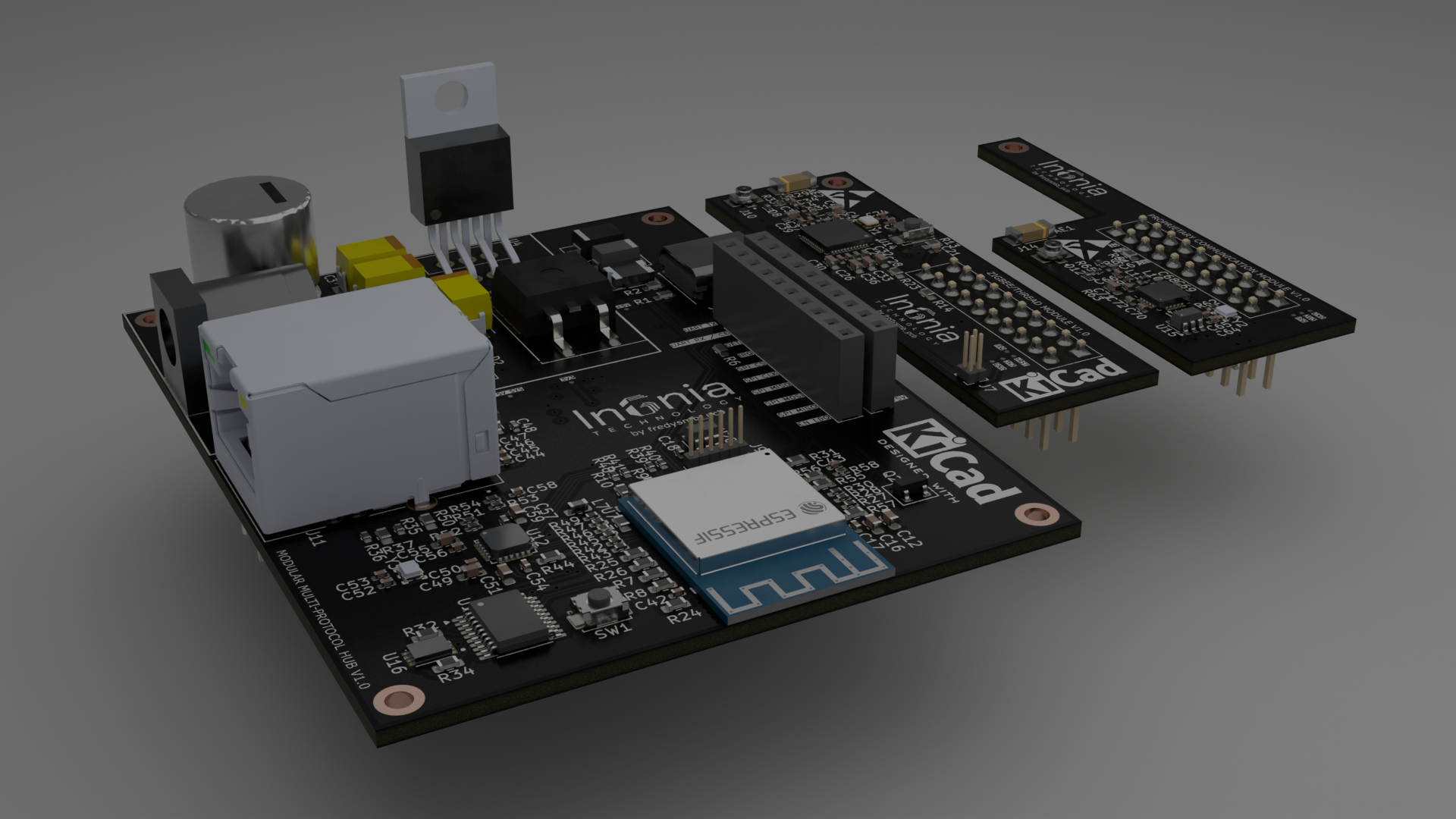
Electrical and functional performance requires testing on physical hardware. No unmeasured results are presented as verified.
The problem
Explore adding or swapping radio technologies without redesigning the host board, while keeping an identifiable and documented electrical interface.
Requirements and scope
- ESP32-S3 host board.
- Interchangeable radio modules.
- EFR32MG24 integration for Zigbee/Thread in one module.
- Module identification with I²C EEPROM.
- Defined power, communications and programming interfaces.
System architecture
A host board provides processing and shared resources. Radio modules encapsulate technology-specific functions behind a common expansion interface. An EEPROM identifies the connected module; actual interoperability still needs hardware and firmware validation.
Engineering decisions
- Separate radio functions from central processing to support hardware variants.
- Define a reusable expansion connector and signal allocation.
- Identify modules through I²C EEPROM rather than manual configuration alone.
- Recognize cost, connector, size, compatibility and RF trade-offs that require measurement.
Verification plan
- Verify supply rails, power-up sequencing and current for each host/module combination.
- Test module identification and incompatible-module handling.
- Validate host/module communications firmware.
- Measure RF performance and review regulatory needs before any commercial product.
Outcome and limitations
The modular architecture, host/module schematics and PCB designs are documented. Prototyping, software, interoperability, RF tests and connector validation remain pending.
Public documentation
The repository contains published design materials for this project. Check its contents and license before reusing any files.